Showing posts with label Life. Show all posts

The Resurrected Life: Living Life a New Way

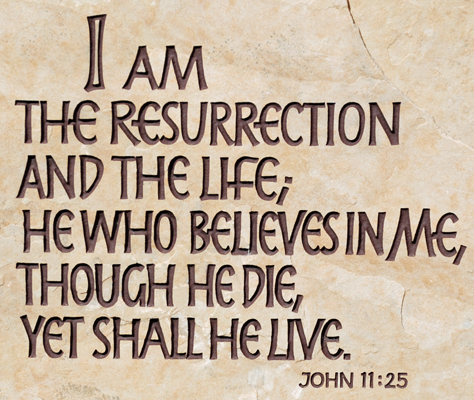
The celebration of Christ's Resurrection is not simply remembering a miracle that happened to Jesus. In celebrating Easter, we proclaim that existence has fundamentally changed. The cosmos has shifted. Life is no longer limited by death.

For Christians, this understanding informs our whole identity - our thinking, our self-image, our choices, our decisions, and our perspectives. We don't have "all the time in the world." Our time on earth is relatively short. Our time here, in this life is a gift. But it's a gift meant to be given away, especially since we have all eternity afterwards.

Jesus?the Resurrection & the Life ImageFrom a resurrection point of view, Jesus' teachings make a great deal more sense. Living in fear seems obsolete when we know how our earthly story ends. (It ends in restoration and resurrection.) Living selfishly seems unfathomable when we have such a short time on this earth to share with those who have such great need. (We know all needs will be met in God's perfect time, especially in the hereafter.) Power, fame, and riches are so fleeting, especially when they are based on a corrupt culture that is dying away. (Christ tells us to base our lives on eternal values that will never fade.)

In the next 50 days (Yes, that's right. The Church celebrates Easter for 50 whole days!) we'll be anchoring ourselves in the Resurrected identity. We'll be unlearning the lessons of mortality and learning to think and act as God's immortal children, for that is what we are, in this life and the next.
     

Overwhelmed? Empty? Finding our Balance in Life

It's November and here they come... the Holidays:
   Tons of food with calories galore,
       lots of family and all those complicated relationships,
           gifts and decor to buy with increased spending, bills, and debt,
     or perhaps none of these. Maybe the Holidays leave us feeling utterly desolate and hollow. Or maybe overwhelmed and hollow.

Isn't there a balance? Must we be either overwhelmed with too much or left feeling empty and hollow?


The Christian spiritual discipline answering that question is called "stewardship". Now before you move on to something else, hear me out. I'm not speaking primarily of money. I'm speaking of governing everything God has given us in this life, including time, relationships, skills, character, and wealth.

Stewardship IS the counterbalance to feeling overwhelmed by life or feeling life is hollow. The fundamental paradigm of stewardship is this:

All we have is given us by God and none of it truly belongs to us. 

Our time is life is limited. The amount of money we can make in a lifetime is limited. The number of skills and talents we can develop is limited. Even the number of meaningful relationships we can have is limited. Thus stewardship is the spiritual discipline of using all these well, to their full potential.

That might sound like 'investing', using our resources well to maximize their potential, but there is a key difference between investing and stewardship. Investing is designed to serve our own personal ends, whether personal gain, philanthropy, or future planning. Conversely, stewardship is aimed at whatever God is aiming at. We never achieve lasting balance by getting what we selfishly want. What God wants is ultimate abundance and equity for all. But, like successful investing, wise stewardship doesn't happen accidentally! Thus the second key to stewardship and to balance is this:

God knows better than I, the greatest good that can come from the gifts God has given me. 

Let's go back to the Holidays and either being overwhelmed or left bereft. The balance of stewardship comes from appealing to God's will over our own and over the pressures of society and family. Just because we want it doesn't mean we should get it. Just because others ask it of you doesn't mean you have to give it. Stewardship is asking "What does God want of me with what God has given me" and knowing that God will give you everything necessary to do what God hopes of you.

Stewardship keeps us from straining to acquire, hoard, and protect what is ultimately God's. And stewardship protects us from coming away empty handed in the end. Be good stewards. Find the balance God intends for your life.


Why is there evil in the World? The Parable of "The Wheat and the Weeds"

When looking at the Parable of The Wheat and the Weeds (or traditionally "Tares") we could address many different topics, but lets talk about what this parable teaches about why evil, corruption, and sin are in the world.

First, notice that the owner of the field did not create the problem. Interestingly, neither is the problem attributed to angels or to the wheat. An "enemy" purposefully placed the seed. Thus, from the perspective of this parable, the existence of evil in our lives was originally intended, but intended by the "enemy", not by God.

Second, there is an option to remove evil from the world, but the result is catastrophic, though not complete, destruction of the world. Take a look at the story of Noah, his family, and the Flood, if you want to see what this might look like. Do notice in the story of the Flood that Noah's family returns to the old status-quo (imperfection) almost immediately after disembarking from the ark.

Getting back to the parable, removing the weeds from the wheat would require identifying them early before their roots are entangled, so as not to uproot both, but the challenge here is that early sprouts may look much the same. Errors in judgement would presumable be frequent.

Alternatively, reapers could wait for the plants to bear fruit, and identify each by its fruit. This would be best done at the harvest when all is ripe, because now the roots are entwined and pulling up one would mean pulling up the other. Problem is, the wheat and the weeds exist in conflict and competition.

The parable says that God has chosen to allow the weeds for now to preserve the wheat. In a sense, God allows for evil and for pain, so as not to destroy what good there is. Difficult to accept? Yes. But then faith is trusting that God, who is omniscient (all-knowing), has a better perspective of this problem than we do. And this makes sense. After all, our perspective comes from maybe 80 years of personal experience and the perspective on one individual, namely "me". God's perspective, even if God weren't omniscient, comes with a great deal more knowledge and experience. So, personally, I think God might be the expert here.

That doesn't make evil any more tolerable. Nor does that make God's decision any easier to bear. Thus Christ says, "Take up your cross and follow me." Life is a mixed bag. And perhaps some fields will have more weeds that wheat or vice versa.

What does give us hope is the end of the parable. God collects all of the field, weeds and wheat, and separates the two. For those who are worried about that separation and its implications, keep in mind that the weeds want to dominate (choke out the wheat) and the wheat wants to grow in peace. No one, however, wishes to be thrown in the fire, but burning was a common method for containing that which is contagious or spreads unchecked.

The point here is that there is consequence and justice. Both what we do and who we are have meaning and purpose. And that is the Christian Hope, the aspiration of the Church - to be what God has intended and do what good and right and pure, as God intended. We want to see God's creation, including ourselves, made whole. We want to be wheat in God's fields, citizens of Heaven even while on earth.
 

The Power to Live Life Abundantly


It’s a busy season. Final exams and papers, graduations, end of the year parties, finalizing summer vacation plans, garden planting, and out outdoor projects abound. Life’s busyness is abundant. But when Christ said, “I have come that you might have life and have it more abundantly,” I’m pretty sure he didn’t mean that he came to fill up our “to do” lists and schedules. Abundant life is something else.

PentecostIn June we celebrate both the Ascension (June 2nd) and Pentecost (June 12th). These are two of the Seven Principle Feasts of the year. (Christmas and Easter are another two). Ascension celebrates Christ’s authority, his honor and power as ruler and governor seated “at the right hand of the Father”. In this celebration we recognize Christ’s power over our lives and over the universe. It is a celebration and acclamation that love, self-sacrifice, mercy, and justice rule – not greed, revenge, and spitefulness.

And lest you think that God has abandoned us on Earth in order to rule in Heaven, Pentecost is the celebration of God’s Holy Spirit indwelling God’s people, giving them the power to live in God’s kingdom on Earth, even in the midst of brokenness and evil.

These are beautiful days! These are days of abundance! And so when the busyness of seems to overtake us, the message of these Principle Feasts remind us that God’s abundant life is greater. Perhaps our motto should not be carpe diem, “seize the day” as we live life, but carpe regnum, “seize the Kingdom.” And thanks be to God, we can seize the Kingdom by the power of the Holy Spirit within us!

Alleluia!