Showing posts with label Jesus. Show all posts

Lent: Moving Further into the Reality of God

It may seem an odd thing, but every year I enjoy Lent just a bit more. At first glance it seems to be a season all about sin, confession, penitence, repentance, and penance. It can feel like we're all about finding out how bad we are and how sorry we ought to be. They're is room for that, but that dreary vision of Lent has very little Gospel, very little Good News, at all. Let's go a bit deeper.

Jesus said in John 3:17 that "God did not send his Son into the world to condemn the world, but that the world through him might be saved." The message of God in the Gospel of Jesus Christ isn't "You're terrible!" The message is, "It doesn't have to be this way. YOU don't have to be stuck anymore." Or as Jesus said, "The Kingdom of Heaven is at hand" (Matt. 10:7).

Sometimes we Christians miss the eternal perspective. We think, for instance, that the Salvation of Christ is something that happens after we die and once we reach Heaven. Or we think that the Salvation of Christ is about reforming our society in the here and now. When Christ saws, "The Kingdom of God is at hand" it means all of these! Salvation is about my own life here and now and the hope of Heaven after I die. Salvation is about a just, peaceful, and loving society here and now, and about Christ's coming again to straighten out all humankind. It is me and everyone. It is now and in the future.


In Advent we make room in our lives and communities for person of Jesus Christ. In Lent we make room in our lives and communities for what Christ is doing, namely altering our reality by overshadowing it with God's reality. In Advent Christ moves into our neighborhood (John 1:14, The Message). In Lent, God begins to move us into God's neighborhood. And then in Easter, we celebrate (in the present) the eternity of living in that neighborhood!

I think we can easily miss the Good News of this. We might be underestimating the power of God's reality now. Instead we buy into the world's reality. Our consumer society judges life based on what you produce (your career and income level) and what you consume (lifestyle). God's reality is based on who you are (intrinsic value) and how God is working in your for the benefit of you and others (mission and ministry). In a materialistic society, what we own or can buy is prized. In God's reality the gifts of God has given us and gives through us are most prized. In an imperfect world we become perfectionists or pessimists. In God's reality, we become a people of redemption and hope - all things can and will be fixed!


The good things of the Kingdom of God are unatainable in this life, because at Baptism, "this life" begins our eternal life. When Jesus says, "The Kingdom of God is among you," in Luke 17:20 (emphasis mine), Christ is saying stop looking elsewhere! It's right here, now, with you, and with those gathered around Christ.

This Lent I hope and pray both you and I find the joy of moving a bit further into God's neighborhood, of buying into God's reality, and giving up that old life that is so unbecoming of the Children of Heaven.

"The time is fulfilled, and the Kingdom of God has come near; repent and believe in the Gospel."  (Mark 1:14-15)

A Reflection for Thursday, Lent 1, Year C

A depiction of 'Christian' fromm John Bunyan's Pligrim's Progress


"Strengthen us, O Lord, 
by your grace, 
that in your might we may overcome all spiritual enemies, 
and with pure hearts serve you; 
through Jesus Christ our Lord, 
who lives and reigns with you and the Holy Spirit, 
one God, 
for ever and ever. 
Amen." 

The collect above is proscribed for the Thursday of Lent 1 by the Episcopal Church's book, Holy Women, Holy Men (p. 39). 

For reflection: In the ancient martial classic, The Art of War, Sun Tzu said "Know your enemy" (Ch. 3, last sentence). What spiritual enemies are opposing your life in Christ? How about the spiritual enemies your Christian community or Church faces? Name them. How may we face those enemies with God's grace and might, yet maintain a 'pure heart' in service to God? 

Read, reflect on, and pray Psalm 35. 

How to Find Time for God

It's ironic. We frequently find that we have little time in our lives for the One who created and gave us our time. But there it is, sad and true. Many of us want to take some time out for God, but somehow we never quite get there. Is there any help for us, beyond guilt-ridden consciences? Absolutely.

A Story. When I was a seminarian, I sat before a group of lay persons and we discussed God's calling on my life. My bishop had told all the seminarians that we were now "under orders", meaning that several things were no longer optional, including daily Morning and Evening Prayer. I confessed to my group that I just couldn't do it. There was no time. The expectations were too high, too unreasonable given all the other things I was expected to do. I've never forgotten what the Sr. Warden said to me, in part because it ticked me off. He said, "If it's important to you, you'll do it."

Well! Imagine the nerve! He was implying that making time for God was just not as important to me as other things! And he was right. Oh, I thought prayer and worship and spirituality were important, but I hadn't made them as important as other things in my life. There is a reason why God linked sacrifice with forming a bond and connection with the Divine. We may not be offering sheep and bulls anymore, but finding time with God today still requires a sacrifice. We must lay our schedules, priorities, desires, needs, and wants on the altar.

"Why would we do that!?" For the same reason we do it with other relationships. We often sacrifice for our families, friends, careers, habits, and needs. We do it because it brings us pleasure or we receive or hope to receive something greater than what we sacrificed. For instance, I make time for my wife and family because they are more important than many other things and our relationships will outlast my career or whatever else threatens to get in the way. In the end, my priorities are determined by my perspective.

"So how about some concrete steps?" Sure. Here are some suggestions, but be aware that like all relationships, your relationship with God is dynamic. There's no simple and guaranteed method. Most of it boils down to just figuring out what works for you. And that is part of the challenge and  part of the adventure. Below are four concrete steps to help you and God figure it out together.

1) Develop your perspective. Write down why you think God wants to spend time with you and why you would want to spend time with God. What are the benefits? Why do you want this to be important? Can you connect a positive relationship with God to the benefit of other priorities? An example on my benefits list is, "I will be a better dad if I nurture my relationship with God." Rehearse the this list by posting it and reading it frequently throughout your week. Pray about it, tell God who you are and who you want to be.

2) Start small. Consistency is more important than length or content at first. Think of it as God wanting to check in with you every day, even if its just the length of a text message with less than 160 characters. A verse and a small prayer is sufficient to start. With consistent practice, you will begin to find that "short" is not long enough.

3) Remove barriers. As you encounter barriers, write them down. Then make it your goal to remove items from the list or otherwise diminish their effectiveness. For instance, next to "I keep forgetting" put "Make appointment times for God in my schedule." Don't forget to pray about them, too. "God, when I forget you, don't forget me. Call me back to you."

4) Talk about it. Our spiritual lives are personal, but not private. We are not called to hide our relationship with God, but to share with others God's activity in our lives (see Psalm 40:11). In doing so we find we aren't alone in our struggles or in experiencing God's miraculous activity. So ask what others do and what they've experienced. Ask for prayer and offer to pray for others.

Let's check in with God and let's check in with each other. It's all just part of being the Family of God.


A Response to NYT "Can Liberal Christianity Be Saved?"

An op-ed entitled "Can Liberal Christianity Be Saved?"  by Ross Douthat in the  New York Times offers a poignant critique of liberal Christianity and holds, in my opinion, some worthy points of consideration for many Episcopalians. 

To begin let me offer a note about conservative and liberal forms of Christianity here. In my opinion, conservative Christianity is more likely to pull away from the the societal trends surrounding it and 'conserve' the methods, ideas, arguments, and paradigms of the past. Liberal Christianity has the tendency to adapt to to the culture and society surrounding it, and be more "free" in its acceptance of contemporary trends and innovations. When we are honest with ourselves, none of us are fully 'liberal' (i.e. accepting everything freely) or fully 'conservative' (i.e. refusing everything new or innovative). Christianity has been, as Jesus was, both conservative and liberal.  

Why the discussion about conservative and liberal? Because I believe that Mr. Douthat is correct. The Divinity of Christ, personal conversion, societal transformation, and the mission of the Church are quite necessary elements of Liberal Christianity - elements, that some liberal Christians may have indeed forgotten or lost. In some, perhaps even many, places, Episcopalians have adopted the culture around them, rather than adapted to it. The critique of conservatives, which is outside the scope of aforementioned article, is to question whether conservatives are resisting not the innovations of human culture, but the call of God for change, growth, and sanctification. I would argue here that when conservative Christianity fails this question, it too has lost sight of the Divinity of Christ, personal conversion, societal transformation and the mission of the Church. 

It doesn't matter - conservative or liberal. Christianity asserts that Christ is Sovereign. Jesus is Lord. When, by grace, we accept God's supremacy in our lives, we will and must be changed by this faith (Eph. 2:8). As our lives change and conform to the Gospel, we will also work to transform our societies, because we love the people, our neighbors, that constitute them. And the mission of the Church is salvation in Christ, both temporal (now) and eternal (forever), physical (body) and spiritual (soul), individual (me) and corporate (us). 

Can Liberal Christianity be saved? I think only if the focus shifts from "Liberal" and returns to "Christ(ianity)". But beware: when that shift is made, worrying about "liberals" or "conservatives" will be among the least of any Christian's concerns.    

The Resurrected Life: Living Life a New Way

The celebration of Christ's Resurrection is not simply remembering a miracle that happened to Jesus. In celebrating Easter, we proclaim that existence has fundamentally changed. The cosmos has shifted. Life is no longer limited by death.

For Christians, this understanding informs our whole identity - our thinking, our self-image, our choices, our decisions, and our perspectives. We don't have "all the time in the world." Our time on earth is relatively short. Our time here, in this life is a gift. But it's a gift meant to be given away, especially since we have all eternity afterwards.

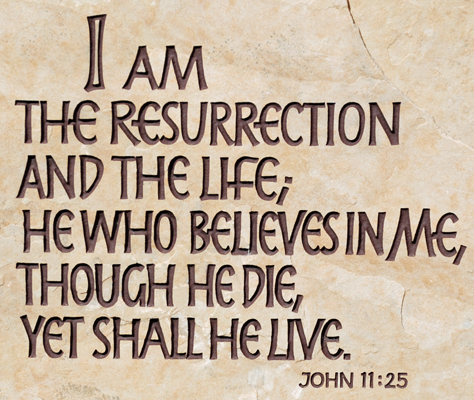
Jesus?the Resurrection & the Life ImageFrom a resurrection point of view, Jesus' teachings make a great deal more sense. Living in fear seems obsolete when we know how our earthly story ends. (It ends in restoration and resurrection.) Living selfishly seems unfathomable when we have such a short time on this earth to share with those who have such great need. (We know all needs will be met in God's perfect time, especially in the hereafter.) Power, fame, and riches are so fleeting, especially when they are based on a corrupt culture that is dying away. (Christ tells us to base our lives on eternal values that will never fade.)

In the next 50 days (Yes, that's right. The Church celebrates Easter for 50 whole days!) we'll be anchoring ourselves in the Resurrected identity. We'll be unlearning the lessons of mortality and learning to think and act as God's immortal children, for that is what we are, in this life and the next.